

The ABCDE rule
The ABCDE rule – assessing moles correctly
Moles (pigmented lesions) are usually harmless. Nevertheless, it is important to recognise changes at an early stage, as skin cancer, especially malignant melanoma, often develops from existing or newly appearing moles.
The ABCDE rule is a simple and proven method for detecting suspicious skin changes at an early stage.
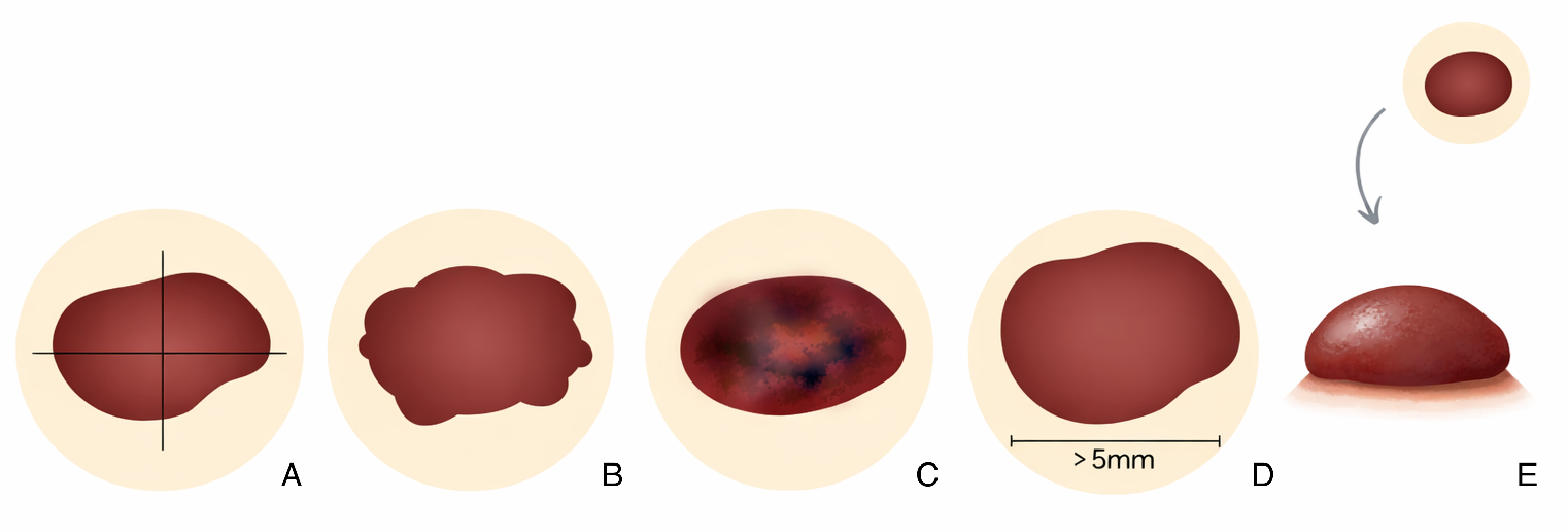
A – Asymmetry
A – Asymmetry
Benign moles are usually symmetrical. If a mole appears uneven or one half is significantly different in shape from the other, this should be checked by a dermatologist.
B – Border
B – Border
A blurred, irregular or jagged border can be a warning sign. Benign moles usually have a clear and even border.
C – Colour
C – Colour
A mole should be as uniform in colour as possible. Multiple shades within a mole (e.g. light and dark brown, black,
reddish or grey) can be suspicious.
D – Diameter
D – Diameter
Moles with a diameter of more than 5 mm should be monitored and checked, especially if they grow or change.
E – Evolution
E – Evolution
Changes are one of the most important warning signs. These include growth in size, changes in colour or shape,
itching, bleeding or scabbing.
When should you see a doctor?
If one or more of the above criteria apply, or if you notice a mole that differs from the others (‘ugly duckling’), we recommend that you seek prompt dermatological clarification.
Regular skin checks, both independently and by a specialist, are an important part of skin cancer prevention.