


Age warts (seborrhoic keratoses)
Seborrheic keratoses, also known as age spots, are benign, common skin growths that develop over the course of a lifetime. They can be brown, gray, or skin-colored and often appear as if "sticked on." Although completely harmless, they are frequently perceived as cosmetically bothersome or mistaken for skin cancer.
At the Decamed Skin and Laser Center, we remove age spots gently, precisely and with aesthetic standards, e.g. using lasers or gentle ablation.
Table of Contents
- What are age warts?
- Causes & Origin
- Symptoms & typical locations
- Are age spots dangerous?
- Treatment options
- Procedure for the removal
- Healing & Aftercare
- FAQ - Frequently Asked Questions
1. What are age warts?
Seborrheic keratoses are benign skin growth disorders that commonly appear from middle adulthood onwards. They are:
- superficial
- slightly raised
- soft or crusty
- brown, grey, black or skin-colored
They typically look as if they are "stuck onto the skin".
Treatment options
Treatment options
The exact causes are not fully understood, but the following factors play a role:
- genetic predisposition
- age-related skin changes
- UV radiation as a contributing factor
- familial clustering
Age spots are not contagious.
3. Symptoms & typical locations
3. Symptoms & typical locations
Age spots are particularly common:
- Face
- scalp
- Neck
- Chest & Back
- poor
- hull
Features:
- Different sizes (from millimeters to several centimeters)
- waxy, crusty or smooth surface
- They can itch or become inflamed if they rub against something.
4. Are age spots dangerous?
4. Are age spots dangerous?
No, seborrheic keratoses are completely benign and do not develop into skin cancer.
However, a dermatological examination is advisable if:
- they change rapidly
- They bleed or itch intensely
- Uncertainty exists regarding skin cancer.
- they are aesthetically disturbing
INFOBOX:
Many patients mistake age spots for melanomas. A professional examination provides absolute certainty.
5. Treatment options
5. Treatment options
Removal is purely for aesthetic reasons or is advisable in case of discomfort.
Suitable methods include:
1. Laser treatment
- gentle
- precise
- Ideal for face and sensitive areas
- minimal scarring
2. Shave removal
- gentle removal of the surface layer
- minimal bleeding
- smooth result
3. Cryotherapy (freezing)
- suitable for smaller keratoses
- The lesion falls off a few days later.
4. Electrocoagulation
- pinpoint removal using heat
- very good cosmetic effect
6. Removal process
6. Removal process
- skin disinfection
- Depending on the method, local anesthesia may be used.
- Laser, ablation or freezing
- small plaster for 1-2 days
- immediate social resilience
The procedure usually only takes a few minutes.
7. Healing & Aftercare
7. Healing & Aftercare
- Slight redness or crusting is normal.
- The scabs will come off after a few days.
- Sunscreen for several weeks (important!)
- Nourishing cream to support healing
The skin usually returns to an even and smooth appearance after 5–14 days.
8. FAQ – Frequently Asked Questions
8. FAQ – Frequently Asked Questions
Are age spots skin cancer?
No, they are completely benign. However, they can look similar to skin cancer and should therefore be checked by a doctor if you are unsure.
Will they return after being removed?
The removed wart does not disappear, but new ones can develop because the predisposition is genetic.
Does the removal hurt?
The treatment is very well tolerated; local anesthesia is used if necessary.
Will a scar remain?
Usually barely visible, especially after laser removal.
Can an age spot suddenly grow?
Yes, they can suddenly become larger or darker, but they remain benign.
Conclusion
Conclusion
Age spots are common, harmless, and easy to remove. Modern, gentle methods such as laser or gentle ablation achieve smooth, aesthetically pleasing results, usually without scarring or downtime.
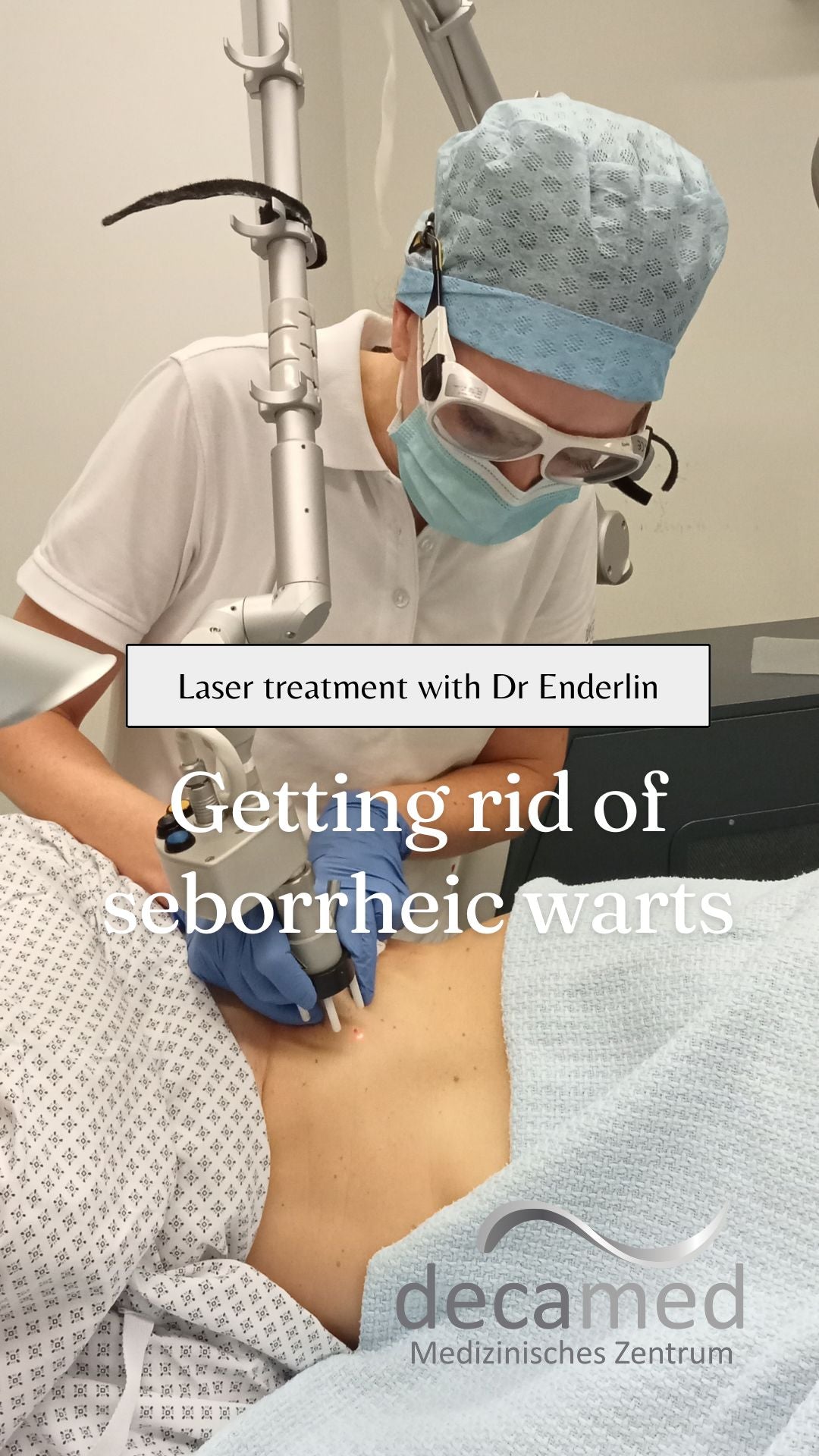
Treatment of seborrhoeic keratosis
Seborrhoeic keratoses (also known as seborrhoeic warts) are benign, wart-like skin lesions that typically occur in adulthood and are considered a common sign of skin ageing. They are medically harmless but can be perceived as aesthetically disturbing.
At DECAMED, seborrhoeic keratoses can be removed quickly, precisely and gently with the CO₂ laser. Laser treatment enables controlled removal of the skin lesion while minimising damage to the surrounding tissue. The procedure is outpatient, short and usually well tolerated. An anaesthetic cream is usually applied beforehand or local anaesthesia (injection) is administered. This makes the procedure completely painless.
After the treatment, targeted night-time care is crucial to support skin regeneration. This also helps the scabs to heal much more quickly.
Dr Enderlin recommends using DECALYS Medical – LE BAUME, a regenerating care product that soothes and protects the skin and optimally supports the healing process. Sun protection is essential after laser treatment. DECALYS Lotion multi défense protects against UVA and UVB rays (SPF 50) as well as blue light. This actively prevents pigmentation disorders.